
What is better than looking at the amazing statistics when we are talking about generative AI (GenAI)? By 2025, the worldwide GenAI sector will have shown an astonishing $71.36 billion, a significant increase from earlier years. It is rapidly expanding by more than 43% in the coming years.
That is why this article will explore the latest advances, their inherent impacts, and several controversies.
New Models and Features to Expect
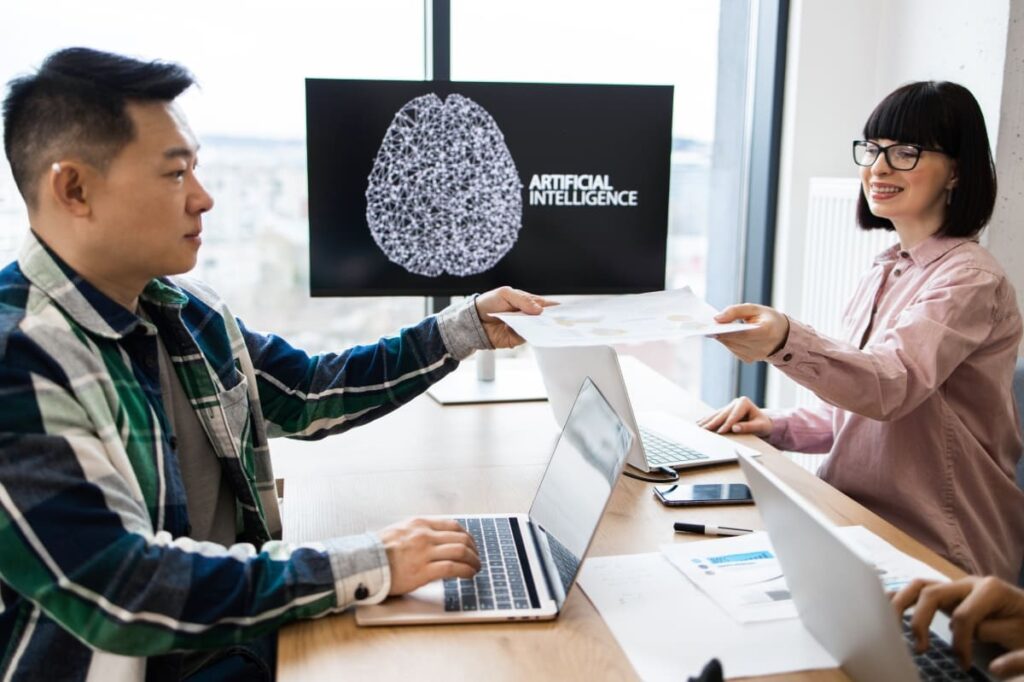
Generative AI: What is It?
A branch of Artificial Intelligence, generative AI models are sophisticated algorithms used in computing. They generate fresh data, such as text, images, or audio, as well as code and synthetic data.
These models acquire knowledge from current data trends and apply that knowledge to develop something original. They create fresh content that resembles what they have learned.
Major Breakthroughs and Features
Generative AI models have the ability to create music, art, and even entire virtual environments. Accordingly, you may already be familiar with several famous GenAI models, like ChatGPT by OpenAI, StyleGAN by NVIDIA, PaLM 2 by Google, GitHub Copilot, or DALL-E 2.
The following are key state-of-the-art developments in GenAI.
- Multimodal AI
Models effortlessly integrate text, images, audio, and video, facilitating cohesive creations (e.g., scripts, visuals, music from a single prompt).
- Autonomous AI Agents and Copilots
Autonomous software automates intricate tasks, ranging from programming to online shopping, and is revolutionizing workflows.
- Real-time GenAI
They are dynamic, data-aware, and contextual, leading to improved search and accuracy. Retrieval-Augmented Generation (RAG) boosts search capabilities by integrating external information and live data.
- Generative models tailored for specific domains
Generative AI tailored to specific domains is projected to transform sectors such as retail, manufacturing, and distribution, improving productivity, personalization, and novelty.
- Small Language Models (SLMs)
SLMs enable AI-driven content creation to reach more accessible industries and platforms. Greater emphasis is on quicker, less expensive, and more private (edge) computation, suited for particular tasks. They will be essential in determining the deployment of AI in real-time applications, providing flexibility, affordability, and rapidity.
- GenAI for Synthetic Data and Simulation
GenAI is emerging as a fundamental element of innovation across sectors such as healthcare, self-driving vehicles, finance, and more. The progression of this technology specifically emphasizes synthetic data generation and simulation.
- Extensive personalization in customer experiences
It leads to a fundamental change in the way companies engage with clients. The emphasis is on hyper-personalization, in which AI customizes each interaction for each individual in real time.
The models use extensive consumer data and adaptive learning to improve and refine the customer experience continually. Prominent examples include customization and realism in gaming experiences, virtual fittings in retail, and adaptive content.
- Scientific Advancement
AI forecasting chemical reactions, supporting drug development, and materials research or science.
The Social Impacts and Other Long-Term Implications

Generative AI is progressively influencing our society. Our systems in health and education, science, public administration, and industrial ecosystems are gradually embracing this technology.
Impacts across Industries
Entertainment and Media
AI creates larger game environments, tailored narratives, and intricate media components.
Workplace
AI assistants revolutionize workflows, programming, content production, and customer support using empathetic, context-sensitive chatbots.
Retail or E-commerce
AI enhances marketing, analyzes trends, and offers virtual fitting (try-on) experiences.
Education
It helps educators in tailoring educational resources and experiences for their students.
Healthcare and Science
Innovations in AI or AI acceleration to forecast illnesses and accelerate research.
The Social Impacts
A truthful parable for the developments and flourishing implications of GenAI is a double-edged sword. They come with positive and negative social impacts at the same time.
The positive impacts include enhanced productivity and efficiency, robust tools for tailored learning, and enhanced diagnostics in healthcare. GenAI also offers greater accessibility, supporting innovation and communication, and helping upskill communities (e.g., Google AI education).
On the other hand, the technology is presenting unexpected implications and risks as well. They involve the dissemination of false information and deepfakes, widening digital divides, reinforcing biases and inequality, triggering privacy and security concerns (cyberattacks), and resulting in job loss (job displacement).
Some Key Controversies
Despite its rising applications, generative AI is inseparable from several controversial issues. Not to mention the societal and ethical impacts above.
Unexplainable Models
GenAI lacks clarity and interpretability. They are not transparent, as their internal processes are not accessible for review. Therefore, it is impossible to determine how they generate the outputs. Ultimately, this lack of clarity is a significant factor contributing to trust concerns regarding GenAI.
Copyright and Data Privacy Violations
GenAI uses content or materials without the owners’ consent, as they are basically extensive datasets—text, visuals, audio, or code—gathered from the Internet. The models overstep data privacy and intellectual property rights.
More controversies are around harmful content distribution, sensitive information disclosure, existing bias amplification, and even the so-called AI hallucinations. Other ethical issues that come to the forefront are energy use, workforces, political impact, and worsening digital poverty.
A global phenomenon, Generative AI has indeed transformed the technology landscape entirely. We have moved beyond the initial excitement and are now firmly in a stage of real implementation and significant effect in various sectors.